
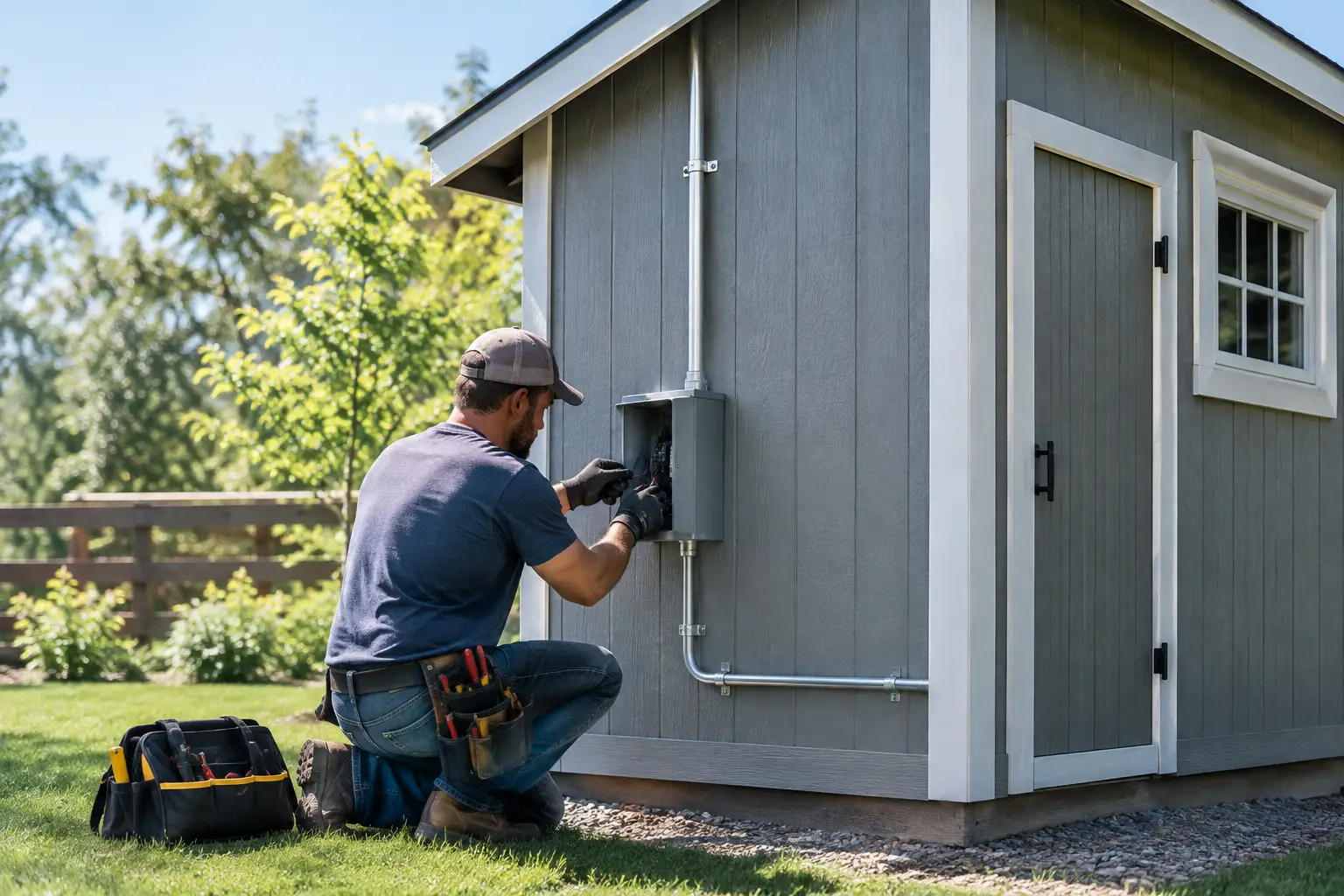
Running electricity to a shed can turn a basic storage building into a practical workshop, home office, or space for outdoor projects. With the right electrical setup, you can install proper lighting, power tools, charge batteries, and use small appliances without relying on extension cords from the house.
Learning how to run electricity to a shed starts with choosing the right power source and understanding how much electricity the building will need. The distance from your house, the equipment you plan to use, and your local electrical code all affect the installation.
For most homeowners who want dependable, permanent power, an underground electrical feeder connected to a subpanel in the shed is a practical long-term solution. It requires more planning and installation work than a temporary power source, but it provides a cleaner setup with room for multiple circuits.
Here is what you should know before starting the project, including wiring options, subpanels, underground installation, safety requirements, and when to hire an electrician.
1. Decide How Much Electricity Your Shed Needs
Before choosing electrical equipment, think about how you will actually use your shed.
A small storage shed with a few LED lights and charging outlets has very different electrical requirements from a woodworking shop with several power tools.
Start by listing the equipment you expect to use:
- LED shop lights and exterior lighting
- Battery chargers for cordless tools
- Laptop computers and small electronics
- Shop vacuums and portable fans
- Air compressors
- Miter saws and table saws
- Electric heaters or air conditioners
Pay particular attention to equipment with heating elements or electric motors. These appliances can draw considerably more power than basic lighting and charging devices.
A small shed used mainly for lighting and occasional charging may be suitable for a dedicated 120-volt, 20-amp branch circuit, depending on the calculated load and installation requirements.
However, a shed used as a workshop may benefit from a larger 120/240-volt feeder connected to a dedicated subpanel. This arrangement provides more flexibility for separate lighting, receptacle, and equipment circuits.
The important distinction is that a 20-amp branch circuit and a feeder supplying a subpanel are not the same installation.
You should also check whether your home’s main electrical panel has enough capacity for the additional load. Having an empty breaker space does not automatically mean the electrical service can support another circuit.
A qualified electrician can perform the necessary load calculations and recommend an appropriate system.
2. Choose the Best Way to Run Power to Your Shed
There are several ways to supply electricity to a detached shed. The right choice depends on the distance, property layout, electrical demand, and budget.
| Product | Best Use | Amazon |
|---|---|---|
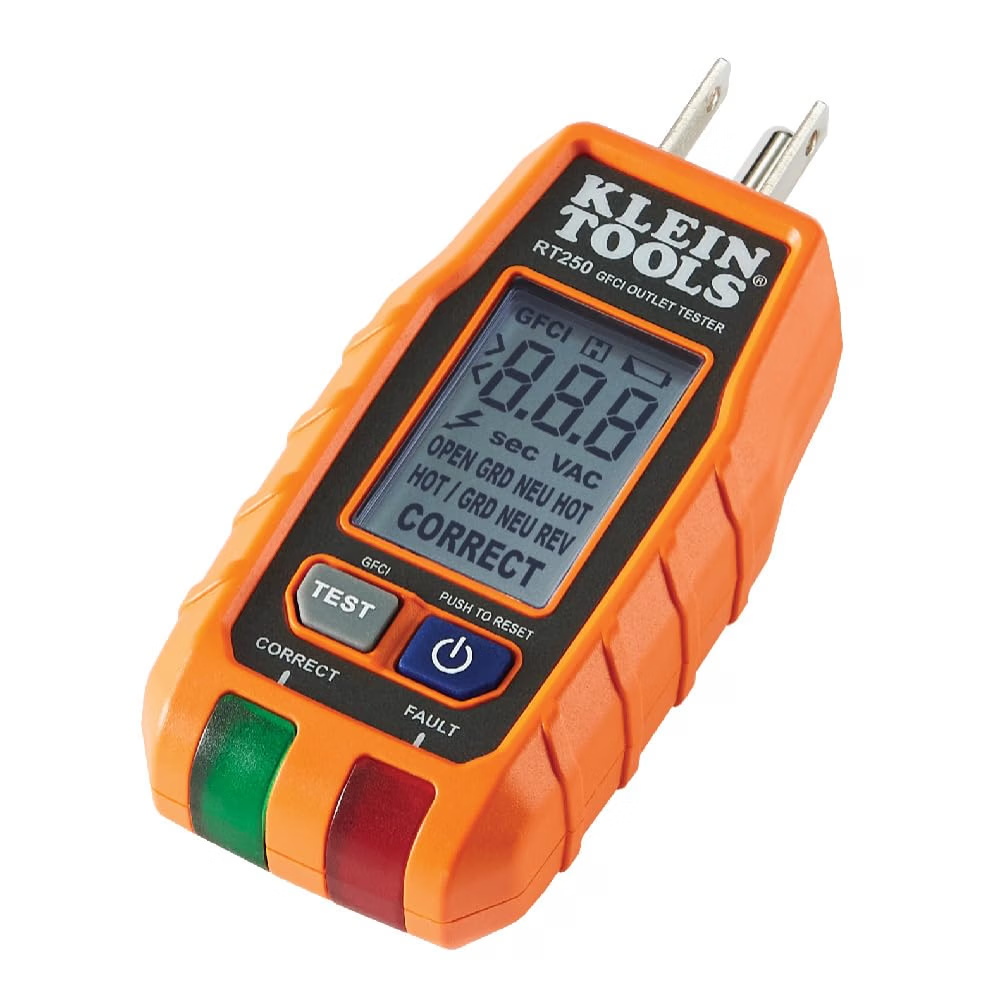
| Klein Tools RT250 GFCI Tester | Testing GFCI outlets | View on Amazon → |
| Amazon Basics Weather-Resistant GFCI | Outdoor electrical outlets | View on Amazon → |
| TayMac MM420C Weatherproof Cover | Protecting outdoor outlets | View on Amazon → |
Underground Electrical Wiring
For many residential properties, underground wiring is the preferred permanent solution.
An underground feeder typically runs from the home’s main electrical panel through an approved underground wiring system and into the shed.
This arrangement keeps the electrical route out of sight and reduces exposure to accidental contact, falling branches, and other outdoor hazards.
A typical underground installation includes:
- A properly sized feeder
- Approved underground conduit or a suitable direct-burial wiring method
- Appropriate electrical fittings and weather-rated equipment
- A disconnecting means where required
- A subpanel when multiple circuits are needed
One important detail is that underground conduit is considered a wet location. Conductors installed inside it must have insulation suitable for wet locations, even when the conduit itself is designed to keep water out.
The installation method, conductor sizing, and burial depth must comply with the electrical code adopted by your local jurisdiction.
Overhead Electrical Wiring
An overhead electrical run may be another option when underground trenching is impractical.
For example, rocky soil, existing concrete, landscaping, or a long distance between buildings can make digging difficult.
However, overhead wiring requires appropriate support, approved conductors, weather-resistant connections, and sufficient clearance from buildings, roofs, trees, and areas where people or vehicles may pass.
It must also comply with applicable clearance requirements and local electrical regulations.
Do not run an ordinary outdoor extension cord overhead or attach an improvised electrical cable between the house and shed.
An electrician can determine whether an overhead installation is permitted and what equipment is required.
Solar Power for a Small Shed
Not every shed needs to be connected to the home’s electrical panel.
A small solar power system may be a practical alternative if your electricity needs are limited.
For example, a solar panel kit connected to a compatible battery and power station may provide enough energy for:
- LED lighting
- Phone and laptop charging
- Small electronics
- Low-power fans
- Occasional battery charging, depending on the system
Solar power becomes less practical when you want to operate high-demand equipment such as electric heaters, large air compressors, or stationary woodworking machinery.
The system must be sized around actual energy consumption, battery capacity, and available sunlight.
If you need dependable power for a workshop, a properly installed electrical feeder will generally provide greater flexibility.
3. Do You Need a Subpanel in Your Shed?
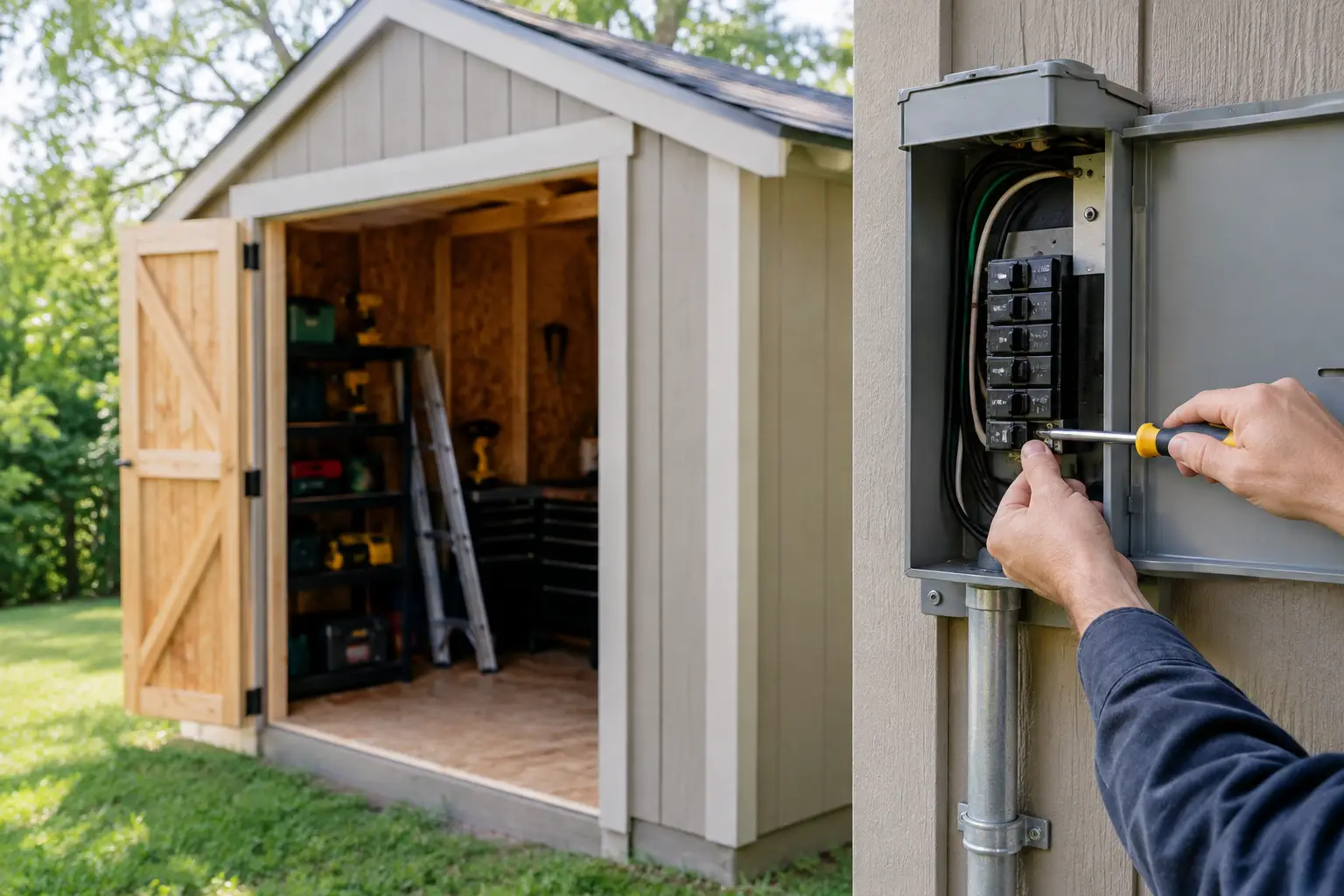
A subpanel is a smaller electrical distribution panel that receives power from the home’s main electrical panel and distributes it to individual circuits inside the shed.
It is often the most convenient arrangement when a detached building needs more than one circuit.
For example, a workshop could have:
- One circuit for overhead lighting
- One circuit for general-purpose receptacles
- A dedicated circuit for a larger appliance or tool, when required
This arrangement allows you to organize the electrical system and manage different loads independently.
If a tool trips its breaker, properly separated lighting circuits can remain operational.
A subpanel also makes future upgrades easier. You might initially install lighting and a few outlets, then add ventilation, exterior lighting, or additional workshop equipment later.
However, a subpanel must be correctly sized and installed.
In a typical feeder-supplied detached building, the neutral and equipment grounding conductors must terminate separately in the subpanel. The grounding and bonding arrangement must also follow the applicable electrical code.
Detached buildings may require their own grounding electrode system, depending on the installation and applicable exceptions.
These are important safety requirements, not optional details.
Have a licensed electrician determine the appropriate panel, feeder, breakers, disconnecting means, grounding, and bonding arrangement for your property.
4. Plan Outlet and Lighting Locations Before Installation
Once you know how electricity will reach the shed, plan where everything will go inside.
This step makes a noticeable difference in how comfortable the building will be to use.
Electrical Outlets
Think about where you will place your workbench, tool storage, charging station, and larger equipment.
For a small workshop, consider placing receptacles:
- Along the workbench wall
- Near the battery charging area
- Where portable tools are commonly used
- Near the entrance for occasional outdoor equipment
Avoid placing outlets where electrical cords will cross walkways or interfere with doors.
If you expect to use a shop vacuum, compressor, or other larger equipment, discuss dedicated circuits with your electrician rather than assuming one general-purpose circuit will handle everything.
Workshop Lighting
Good lighting is just as important as having enough outlets.
LED shop lights are a popular option because they provide useful illumination without consuming as much electricity as many older lighting technologies.
For a compact shed, one central fixture may be enough for basic storage. However, a workshop usually benefits from multiple fixtures positioned to reduce shadows over the workbench.
Consider installing:
- General overhead lighting
- Task lighting above the workbench
- Exterior lighting near the entrance
- Convenient wall switches near entry points
Lighting should be selected for the shed’s temperature, moisture, and environmental conditions.
Outdoor Receptacles
If you plan to use electric lawn equipment or other outdoor tools, an exterior receptacle can be useful.
Outdoor outlets need appropriate weather-resistant equipment and covers. GFCI protection is also an important part of outdoor electrical safety.
The exact requirements depend on the location, receptacle type, and adopted electrical code.
5. Understand GFCI and AFCI Protection
Electrical protection is particularly important in sheds because they may experience moisture, temperature changes, dust, and outdoor exposure.
Two common types of protection are GFCI and AFCI.
GFCI (Ground-Fault Circuit Interrupter)
GFCI protection helps reduce the risk of electric shock by detecting certain electrical current imbalances and interrupting power.
It is especially important in areas where electrical equipment may come into contact with moisture.
AFCI (Arc-Fault Circuit Interrupter)
AFCI protection is designed to detect certain dangerous electrical arcing conditions that could start a fire.
Depending on the adopted electrical code and the type of installation, AFCI protection may be required for some circuits.
These devices serve different purposes. One does not automatically replace the other.
Your electrician should determine which protections are required for the shed’s circuits and where they should be installed.
6. How Underground Electrical Installation Works
An underground installation involves several stages. Understanding the process helps you plan the project and communicate with your electrician.
Step 1: Check Permits and Local Requirements
Start by contacting your local building or electrical inspection department.
Ask whether the project requires an electrical permit, what inspection stages apply, and which electrical code has been adopted.
Do not assume that a permit exemption for constructing a small storage shed also exempts the electrical installation.
Step 2: Evaluate the Electrical Route
The route between your house and shed affects the cost and complexity of the project.
Look for potential obstacles such as:
- Existing water and gas lines
- Irrigation systems
- Tree roots
- Concrete walkways
- Driveways
- Drainage systems
- Existing underground electrical cables
Before excavation, contact 811 to have participating utility lines marked.
This is an essential safety step, even if you already know where some underground utilities are located.
Step 3: Determine the Burial Depth and Wiring Method
There is no single burial depth that applies to every underground electrical installation.
The required depth depends on the wiring method, conduit material, location, and applicable exceptions in the electrical code.
For example, NEC Table 300.5 establishes different minimum cover requirements for different underground installations.
Direct-burial cable, rigid metal conduit, and approved nonmetallic conduit do not necessarily have the same requirements.
The electrician should confirm the exact requirements before the trench is excavated.
Step 4: Install the Underground Conduit or Wiring System
The underground wiring system must use materials approved for the installation method and environment.
If conduit is used, it must be properly sized and installed with suitable fittings and protection where it enters the house and shed.
The conductors must also be appropriately rated for the conditions inside the raceway.
Longer installations may require additional attention to conduit sizing, bends, pulling conditions, and voltage drop.
Step 5: Install the Shed Panel and Branch Circuits
If the project includes a subpanel, the electrician installs and configures it according to the approved design.
The panel then distributes electricity to the individual circuits serving the shed.
This is also where proper grounding, bonding, neutral separation, breaker selection, and disconnecting requirements become particularly important.
Step 6: Inspect and Test the Installation
The underground portion may need to be inspected before the trench is covered.
The electrician should coordinate the inspection schedule with the local authority.
After installation, the electrical system must be tested to verify that the circuits, protective devices, grounding arrangements, and equipment operate correctly.
The trench should only be backfilled after any required underground inspection has been completed and approved.
7. What Can You Do Yourself, and What Should an Electrician Handle?
Running electricity to a shed involves more than installing a few outlets.
Some project preparation can be handled by the homeowner, but the electrical installation itself requires appropriate knowledge and code compliance.
Here is a practical way to divide the work.
Tasks homeowners may be able to handle:
- Planning the shed layout
- Deciding where workbenches and equipment will go
- Listing the appliances and tools they expect to use
- Preparing the interior space
- Coordinating utility marking
- Discussing trench preparation with the electrician
- Handling excavation when permitted and agreed upon
Tasks best handled by a qualified electrician:
- Calculating the electrical load
- Checking the home’s main panel capacity
- Selecting feeder conductors and breakers
- Installing or modifying electrical panels
- Making electrical connections
- Installing grounding and bonding systems
- Determining GFCI and AFCI requirements
- Testing and arranging required inspections
Electrical panel work can expose people to dangerous voltages, even when some breakers are switched off.
Never assume that turning off an individual breaker makes an electrical panel safe to work inside.
A good approach is to discuss the project responsibilities with your electrician before work begins. You may be able to save money by handling approved preparation tasks without taking unnecessary electrical risks.
8. Common Mistakes When Running Electricity to a Shed
Several mistakes can make a shed electrical installation unsafe, expensive, or difficult to upgrade.
Using an extension cord as permanent wiring
An extension cord is not a replacement for a properly installed electrical feeder or branch circuit. It can become damaged by weather, lawn equipment, vehicles, and repeated use.
Choosing an undersized electrical system
A circuit that works for lighting and charging may not have enough capacity for a heater, compressor, or multiple power tools.
Plan around the equipment you actually intend to use.
Ignoring voltage drop
Long electrical runs can experience voltage drop, especially when larger loads operate.
The feeder must be sized according to the calculated load, conductor material, length, and other applicable factors.
Burying wiring without checking the requirements
The required burial depth depends on the wiring method and location.
Never assume that a particular depth is acceptable just because another homeowner used it.
Skipping permits and inspections
Unapproved electrical work can create safety problems and complications with insurance or future property sales.
Check local requirements before starting.
Incorrect subpanel grounding and bonding
The neutral and grounding conductors must be arranged correctly. Improper bonding can create dangerous electrical conditions.
Installing indoor-rated equipment in outdoor locations
Electrical boxes, covers, wiring, and other components must be suitable for the environment where they are installed.
A shed may experience more moisture, dust, and temperature changes than a finished room inside the house.
9. How Much Does It Cost to Run Electricity to a Shed?
The cost depends on the distance from the house, electrical capacity, trenching requirements, soil conditions, and the amount of wiring needed inside the shed.
A simple installation supplying limited power will generally cost less than a complete workshop installation with a subpanel and multiple circuits.
The main cost factors include:
- Distance between the house and shed
- Underground trenching or overhead installation
- Conduit and electrical conductors
- Main panel modifications, if needed
- Subpanel and breakers
- Grounding and disconnect equipment
- Interior outlets, switches, and lighting
- Electrical permits and inspections
- Labor and site restoration
For a rough U.S. market reference, Angi’s October 2026 estimates put the cost of running electricity to a shed or detached garage at approximately $1,000–$3,800 for many projects. More complicated installations can cost considerably more.
These figures are general estimates, not guaranteed prices. A long underground run, difficult excavation, or electrical service upgrade can change the total substantially.
The best way to compare contractors is to request written estimates that clearly identify the feeder, trenching, subpanel, interior wiring, permits, and inspections included in the price.
10. Frequently Asked Questions About Running Electricity to a Shed
Can I run electricity to a shed without a subpanel?
Yes. A shed with limited electrical needs may be supplied by an appropriately designed branch circuit without a separate subpanel.
However, if you need multiple circuits or want to use several types of equipment, a subpanel may be a more practical arrangement.
How deep does electrical wiring need to be buried to a shed?
The required burial depth depends on the wiring method, conduit type, installation location, and applicable electrical code.
NEC Table 300.5 includes different minimum cover requirements for direct-burial cable and various conduit systems. Always verify the rules adopted by your local jurisdiction before excavation.
Do I need a permit to run electricity to a shed?
Many jurisdictions require an electrical permit and inspection when installing a new electrical feeder or branch circuit to a detached building.
Requirements vary by location, so contact your local building or electrical inspection department before beginning.
Is underground wiring better than overhead wiring?
Underground wiring is often preferred for residential sheds because it keeps the electrical route out of sight and away from everyday yard activities.
Overhead wiring may be appropriate in certain situations, but it requires proper clearances, support, and weather-rated equipment.
The best option depends on your property and local requirements.
Can I power a shed with solar panels?
Yes. A solar panel system with a suitable battery can power lights, electronics, and other low-demand equipment.
However, running larger tools, electric heaters, and air conditioners requires substantially more capacity.
Can I use a regular extension cord to power my shed?
An extension cord may be suitable for temporary outdoor use when it is properly rated and used according to its instructions.
It should not be treated as a permanent substitute for a properly installed electrical system.
Final Thoughts
Running electricity to a shed is an investment that can make the building much more useful, especially if you plan to use it as a workshop or a dedicated space for DIY projects.
For a small shed with basic lighting and occasional charging, a properly designed 120-volt circuit may be enough. If you plan to operate multiple tools, heating equipment, or other larger appliances, an underground feeder connected to a subpanel is often a better long-term solution.
The most important step is to plan the electrical capacity, installation route, and safety requirements before any work begins.
A properly designed electrical system will give your shed dependable power, make future upgrades easier, and help you avoid the problems that come with temporary wiring and undersized circuits.
When it comes to electrical connections, grounding, and panel installation, work with a qualified electrician and follow the electrical code adopted in your area.


Leave a Reply